
Boots, Bags & Blackened TailThe exhibit that makes people uncomfortable.
Alligators are farmed. Their hides become handbags and their tails become dinner. That is a difficult thing to put on a family website — until you learn that this trade is a large part of why there are five million alligators alive today.
Nothing Goes to Waste
An alligator taken under a managed harvest yields four quite different products, and every one of them supports a different industry. Click a part of the animal to see what it becomes.
Pick a highlighted section of the alligator and this panel will tell you what that part is used for.
“I'll be honest, this is not my favourite room in the building. But you asked how there came to be five million of us, and the answer is partly in here.”
The Hide
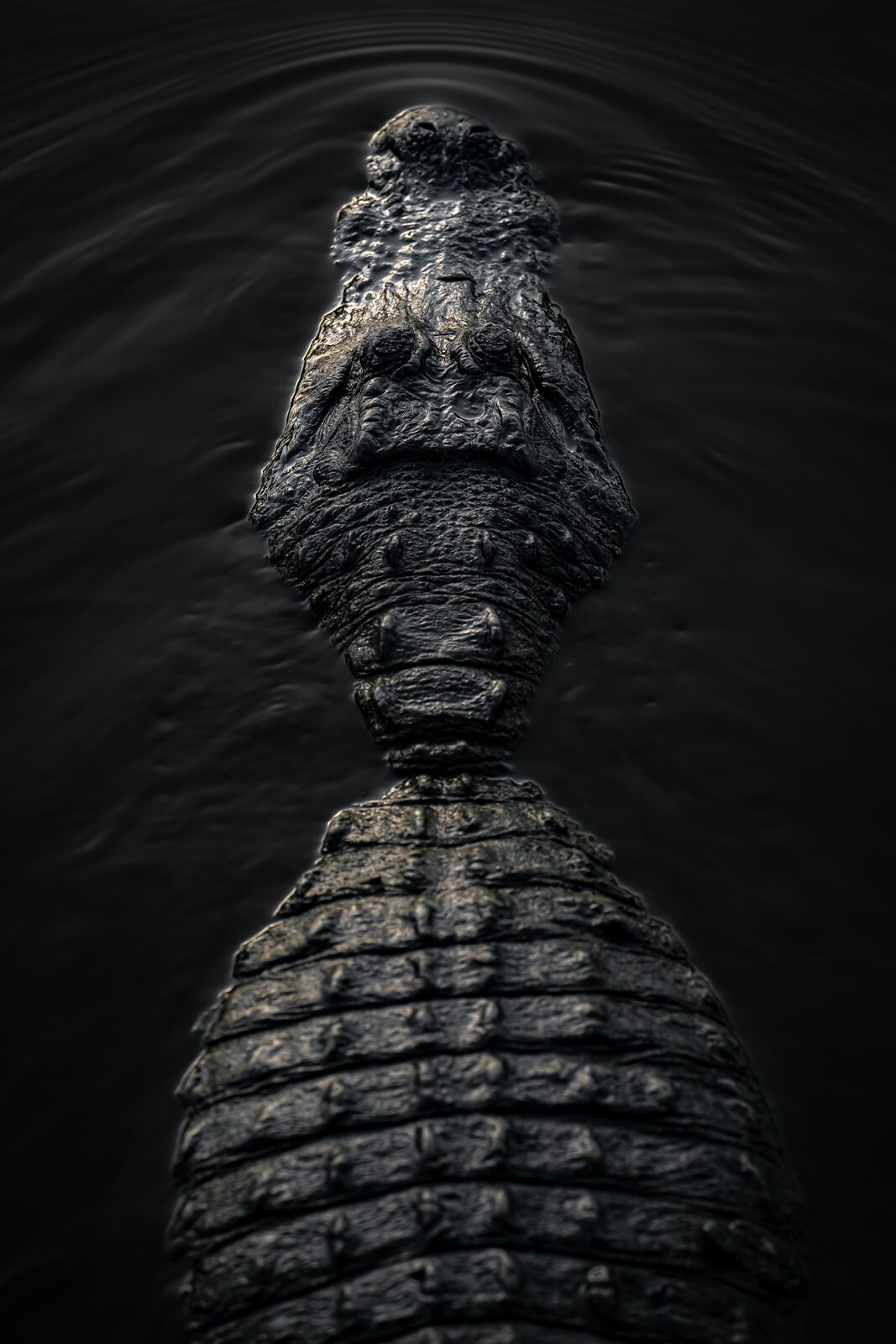
Alligator leather is a luxury material, and the reason is visible in the hero image at the top of this page: a scale pattern nothing else produces, over a hide that is genuinely tough.
It becomes handbags, wallets, belts, shoes and watch straps at the small end, and furniture, upholstery and picture frames at the large end. It takes dye well, which is why you see it in colours no alligator ever wore.
This is also the exact demand that nearly finished the species. Through the 1950s and 60s, unregulated hunting for hides — for shoes, bags and belts — combined with wetland drainage to push the American alligator to the edge. The market did not go away when the animal nearly did. What changed was where the hides came from and who was counting them.
The Meat
Alligator meat is a delicacy in parts of the American South, and a fixture of Cajun and Creole cooking. It is mild — the comparison people reach for is chicken — and it turns up grilled, fried, stewed and smoked.
The common preparations are alligator sausage, alligator ribs and, best regarded of all, tail meat. It is lean, low in fat and high in protein, which is exactly the pitch made for it as an alternative to more familiar meats.
There is a real supply chain behind this: processors and retailers across Louisiana and the Gulf states sell filets, nuggets, tenderloin and ground meat for sausages and burgers. Like the hide trade, it is licensed and monitored.
A note for younger visitors
Some people find this part uncomfortable, and that is a perfectly reasonable way to feel. You can think an animal is magnificent and still disagree about whether it should be farmed. This exhibit lays out what happens and why; what you make of it is yours to decide.
The Paradox
Here is the part that surprises people. The commercial trade in alligators is not separate from the conservation story — it is part of it.
How it works
When the American alligator gained federal protection in 1967, the demand for hides did not vanish. What the law did was make the illegal trade prosecutable, and what farming did was give that demand somewhere legitimate to go — supplying the market without touching wild populations.
Then the mechanism went one step further. Under managed programmes, licensed ranchers may collect a quota of eggs from the wild marsh on the condition that an agreed percentage of the hatchlings is returned to that marsh once grown — and returned at a size where survival odds are far better than they would have been in the wild.
The effect is that a live, healthy wetland becomes an asset a landowner has a direct reason to protect. Drain the marsh and you have destroyed your own supply.
Why it is still contested
None of this settles the ethical question, and it is not meant to. Reasonable people object to farming animals for luxury goods regardless of the population outcome, and that objection does not disappear because the numbers worked.
What is not really in dispute is the sequence of events: legal protection, habitat conservation and regulated commercial use ran together, and the American alligator went from endangered in 1967 to fully recovered by the late 1980s.
Trade is still watched. Harvest and sale are controlled through permits and monitoring by state wildlife agencies, and international trade is regulated under CITES to prevent over-exploitation.
Walk the cycle
Five stages, and the loop only closes because of the last one.
Licensed ranchers take a permitted quota of eggs from wild nests in the marsh.
Incubated and grown on the ranch, safe from the predators that take most wild hatchlings.
Hides and meat reach buyers legally, with permits and monitoring, instead of through poaching.
An agreed percentage is released into the same marsh at a size where survival odds are far better.
The marsh is now worth more intact than drained — so it stays wet, which benefits every other species in it.
Quotas and return percentages are set by the state and have changed as the population recovered. Confirm current figures with the Louisiana Department of Wildlife and Fisheries before publishing a specific number.
“I live in that marsh. I do not have strong feelings about handbags, but I have extremely strong feelings about the marsh still being there.”
Exhibit complete
One hall left, and it is the fun one: the record books, the ghost-white gators, and every myth you have ever been told.