
Tall Tales & Record BooksThe last hall, and the least sensible one.
Giants that were measured, giants that were only ever described, ghost-white alligators that should not survive a week, and a stack of things everyone knows about gators that simply are not true.
The Record Books
In August 2014, a hunting party on the Alabama River took an alligator measuring 15 feet 9 inches and weighing 1,011.5 pounds. It broke the state record for both length and weight, and it remains the number most often quoted when anyone asks how big these animals get.
You will also hear about nineteen-foot alligators. Those claims are historical, and they are the reason the phrase "often debated" attaches itself to this subject: the documentation is thin and the measuring methods behind them cannot be checked. They are not impossible. They are simply unverifiable, which in a record book is the same as no.
For scale: anything over 13 feet is considered exceptionally large. A typical adult male runs 11 to 15 feet. So the Alabama animal was not a different species of monster — it was the far end of normal, which is somehow more impressive.

Ghost Gators
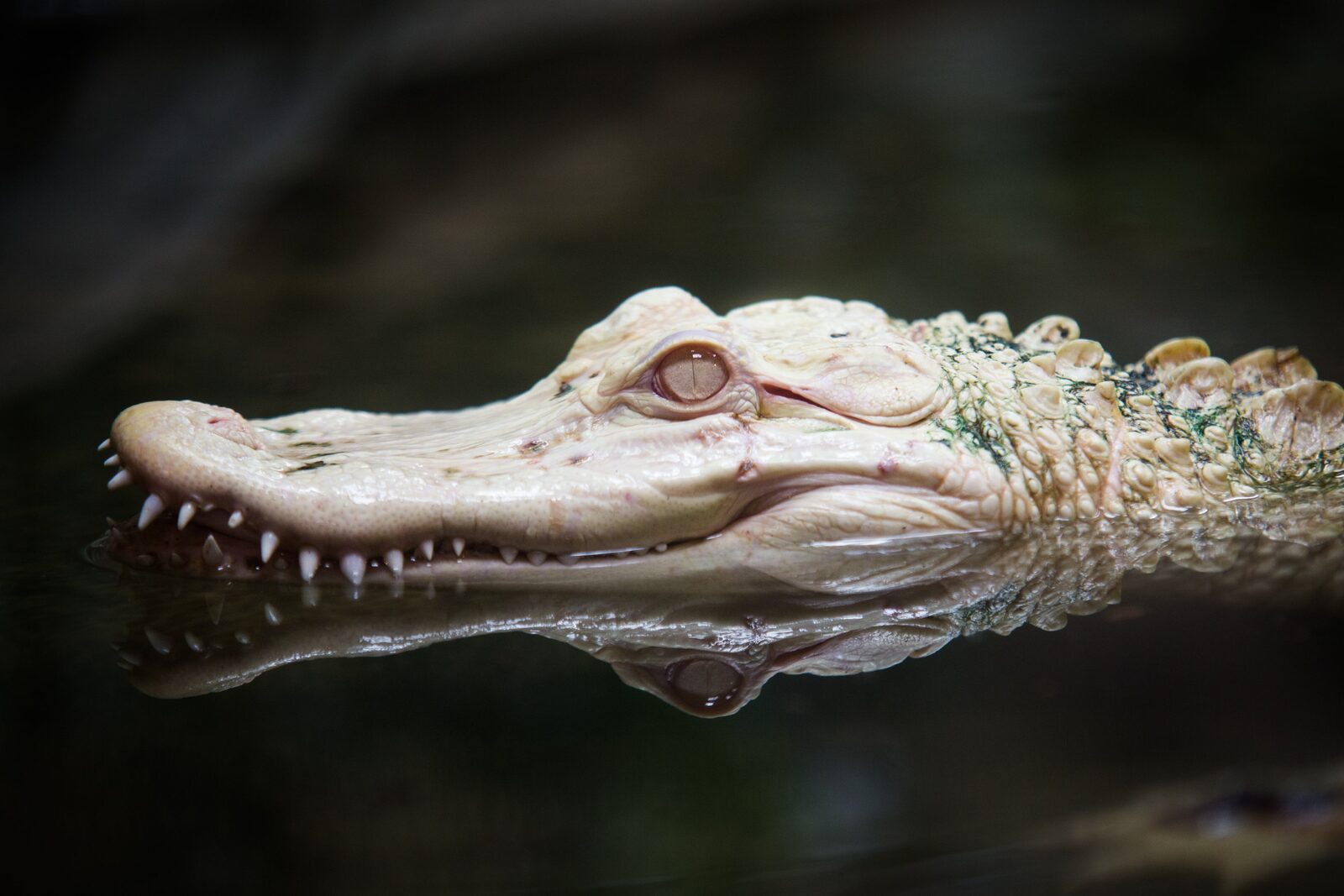
An albino alligator carries a genetic mutation that stops it producing melanin, the pigment behind skin colour. The result is white or pinkish skin and eyes that look red or very pale blue, because with no pigment in the iris you are seeing the blood vessels behind it.
It is recessive. A hatchling has to inherit the gene from both parents to be albino, which is why an animal can carry it invisibly for a whole lifetime and pass it on.
In the wild they almost never last. No camouflage means they are obvious to predators and obvious to prey, and no melanin means sunlight burns them. Nearly every albino alligator you will ever see lives in a sanctuary, zoo or farm, where it can be kept out of direct sun and looked after.
Leucism is a different thing and often confused with it: patchy pale or white colouring, but some pigment survives, and the eyes stay dark. Leucistic animals generally avoid the health problems that come with full albinism.
Breeding simulator: where do ghost gators come from?
Set each parent’s genes and watch the odds. A is the normal gene, a is the albino one — and a only shows up when a hatchling gets it from both sides.
A Punnett square: mother’s genes down the side, father’s along the top, and every box is one possible hatchling.
“Try two carriers. Both parents look completely ordinary and one egg in four comes out white. That is the whole trick of a recessive gene.”
Bust the Myth
Alligators attract folklore the way they attract algae. Ten claims — call each one, and the Truth-o-Meter will settle it.
Where the myths come from
Most alligator folklore is a reasonable guess that hardened into a fact. Nobody invented the zig-zag running advice out of malice — it sounds sensible, it is easy to repeat, and almost nobody is ever in a position to test it.
The dangerous ones are the myths that change behaviour. Believing an alligator cannot climb a fence, or that a certain running pattern will save you, replaces the advice that actually works: keep your distance, and never feed them.
The harmless ones are more fun. There are no alligators in the New York sewers, and there never were.
By the Numbers
The last word belongs to the count — because in 1967 every one of these figures was heading the other way.
Population figures are estimates from the project brief, current to 2023, and fluctuate with habitat change and management. Re-verify with the Florida Fish and Wildlife Conservation Commission and the Louisiana Department of Wildlife and Fisheries before publication.
Where they all are
Louisiana and Florida hold the overwhelming majority. Beyond those two, alligators live in Georgia, Alabama, Mississippi, North and South Carolina, Texas, Oklahoma and Arkansas — ten states in total, though in far smaller numbers.
And you can go and look at them. There is no reliable count of how many alligator parks, farms and sanctuaries operate across the region, but they run from serious zoological institutions to genuine roadside attractions. Gatorland in Orlando bills itself, with some justification, as the Alligator Capital of the World.
“That's the last hall. You now know more about me than most people who live next door to me. Go and see a real one — from a sensible distance.”
All eight halls complete
That is the whole park. Go back for the ones you skipped, or find a real alligator to look at.