
Living FossilsThe design has barely changed since the dinosaurs.
Crocodilians have been running the same basic blueprint for a very long time, and alligators are a fine example of why nobody messed with it. Here is the machinery: the armour, the jaws, the eyes, and the size they get to.
Built Like a Tank
Start with the shape. An alligator is a long, heavy, low-slung body with a tail that makes up roughly half its total length — and that tail is the engine. The legs are short and sturdy, five toes in front, four webbed toes behind. On land they are unhurried. In water they are alarming.
The back is covered in scutes — bony plates, also called osteoderms, embedded in the skin. Armour that also acts as a heat exchanger while the animal basks.
Because alligators are ectothermic, they have no internal furnace. They warm up by lying in the sun and cool down by sliding into the water. A basking gator is not being lazy; it is running its metabolism.
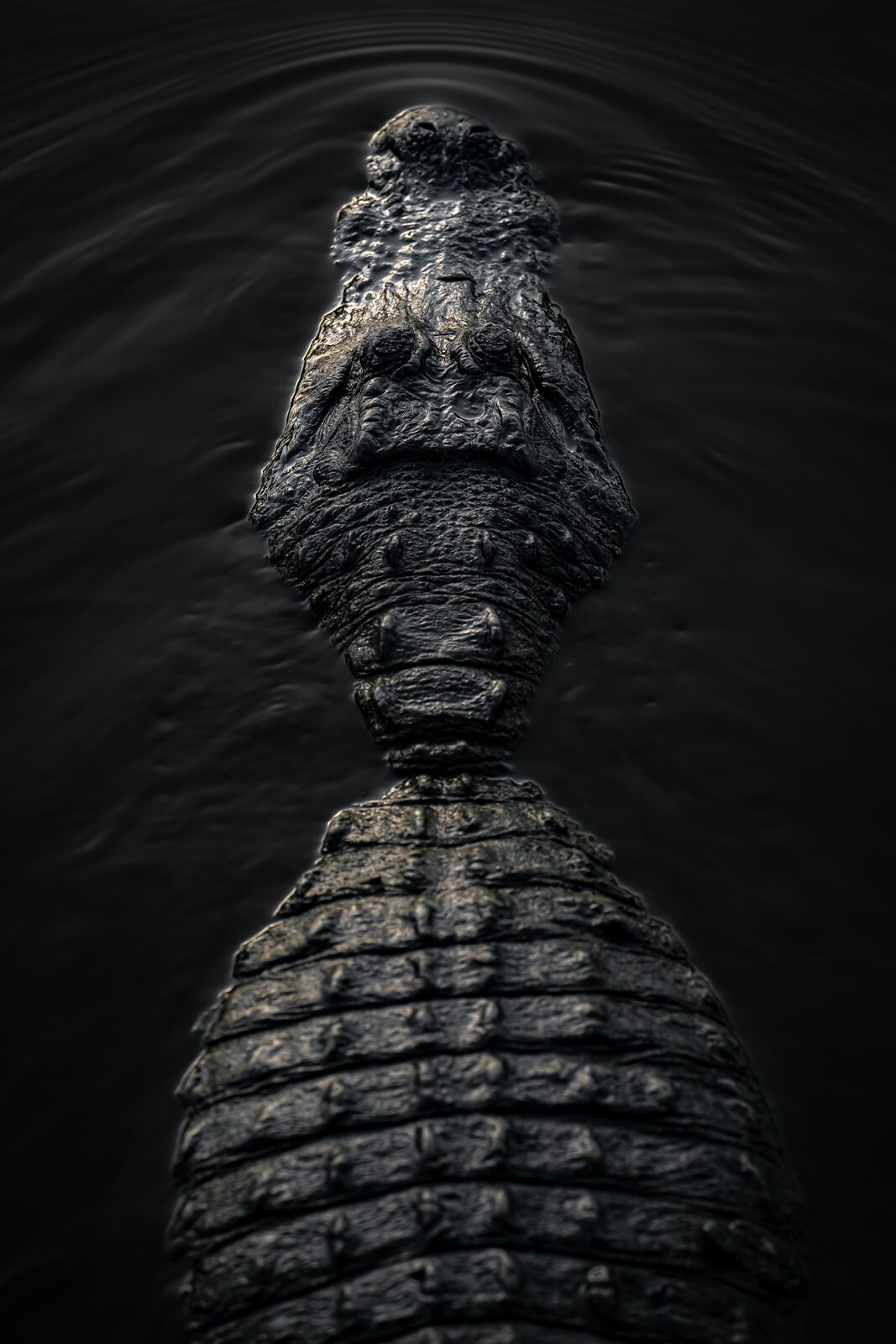
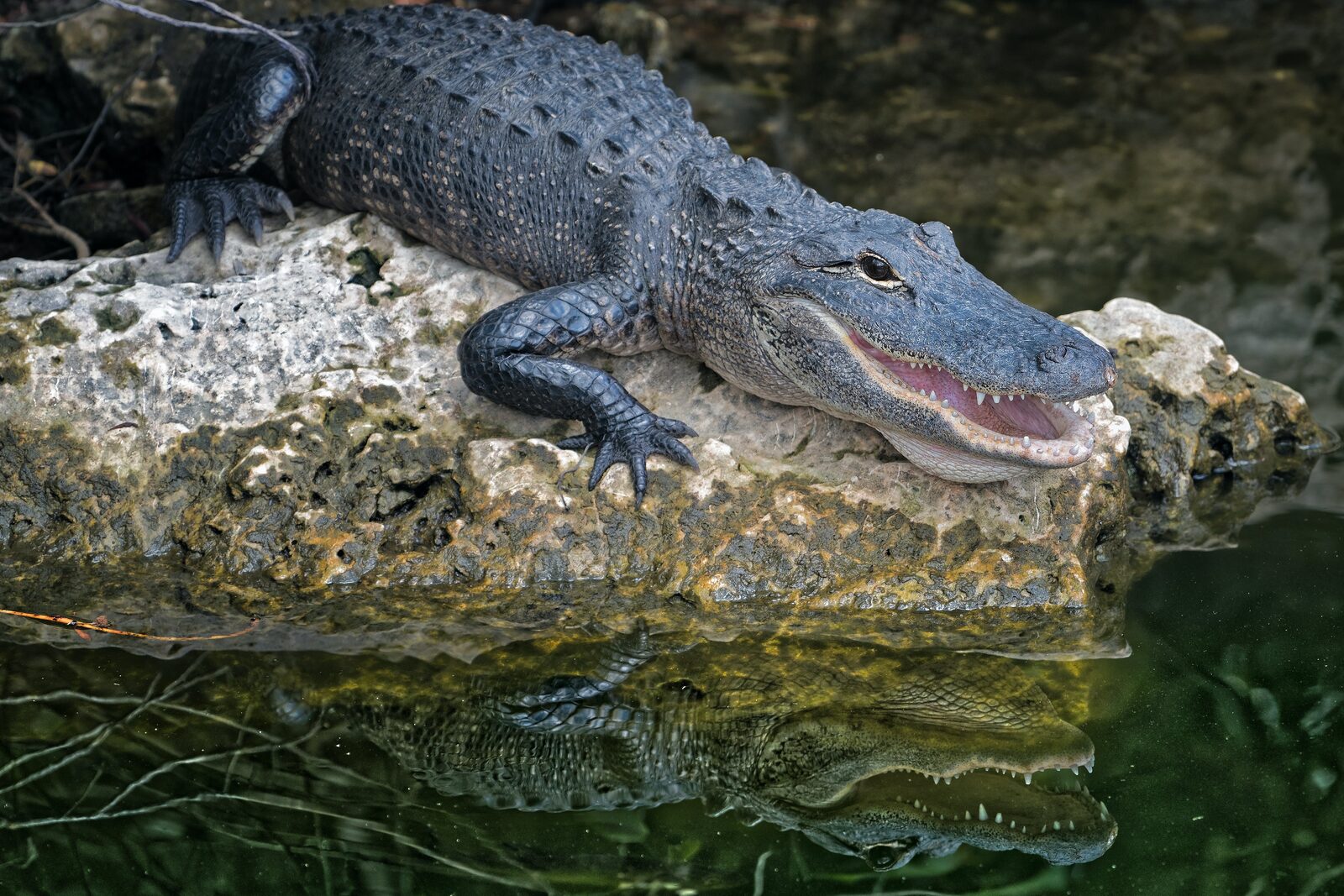
So why do they look green?
They aren't. Alligator skin is dark grey to nearly black — good for soaking up heat. The green comes from three borrowed sources:
- Algae settling into the rough armour of an animal that spends its life in slow, rich water.
- Reflected light off green water and overhanging vegetation.
- Olive and brown tones in the scutes themselves, which read as green in the right light.
The accidental result is superb camouflage — which matters enormously for an ambush predator.
 Hover to find it
There is an entire alligator in that photograph. Photo: Pixabay / Pexels
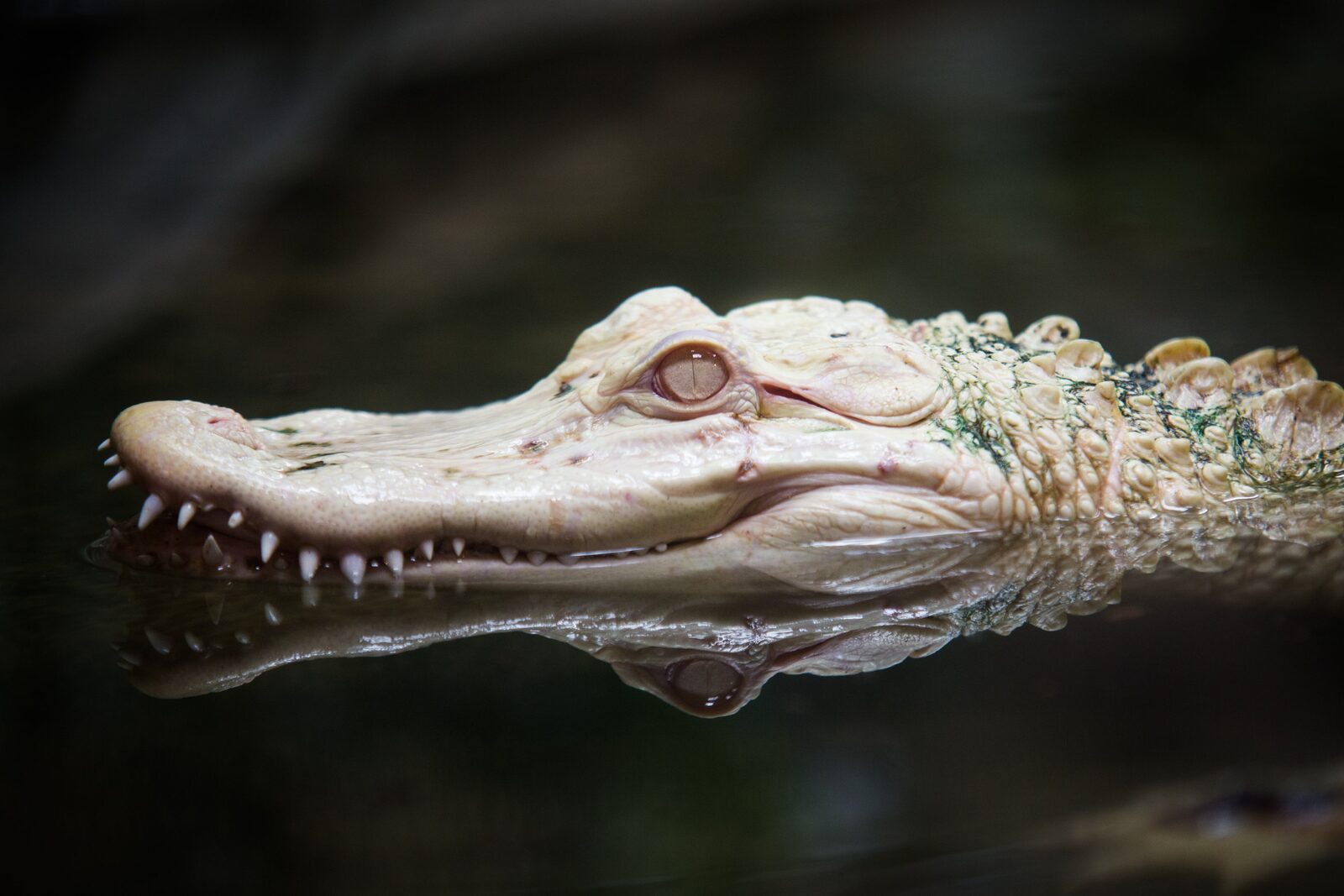
“Every so often one of us turns up ghost-white. Albino gators lack melanin entirely — pink or pale blue eyes, skin that burns in an afternoon. In the wild they rarely last long, so nearly every one you'll ever see lives in a sanctuary.”
The Business End
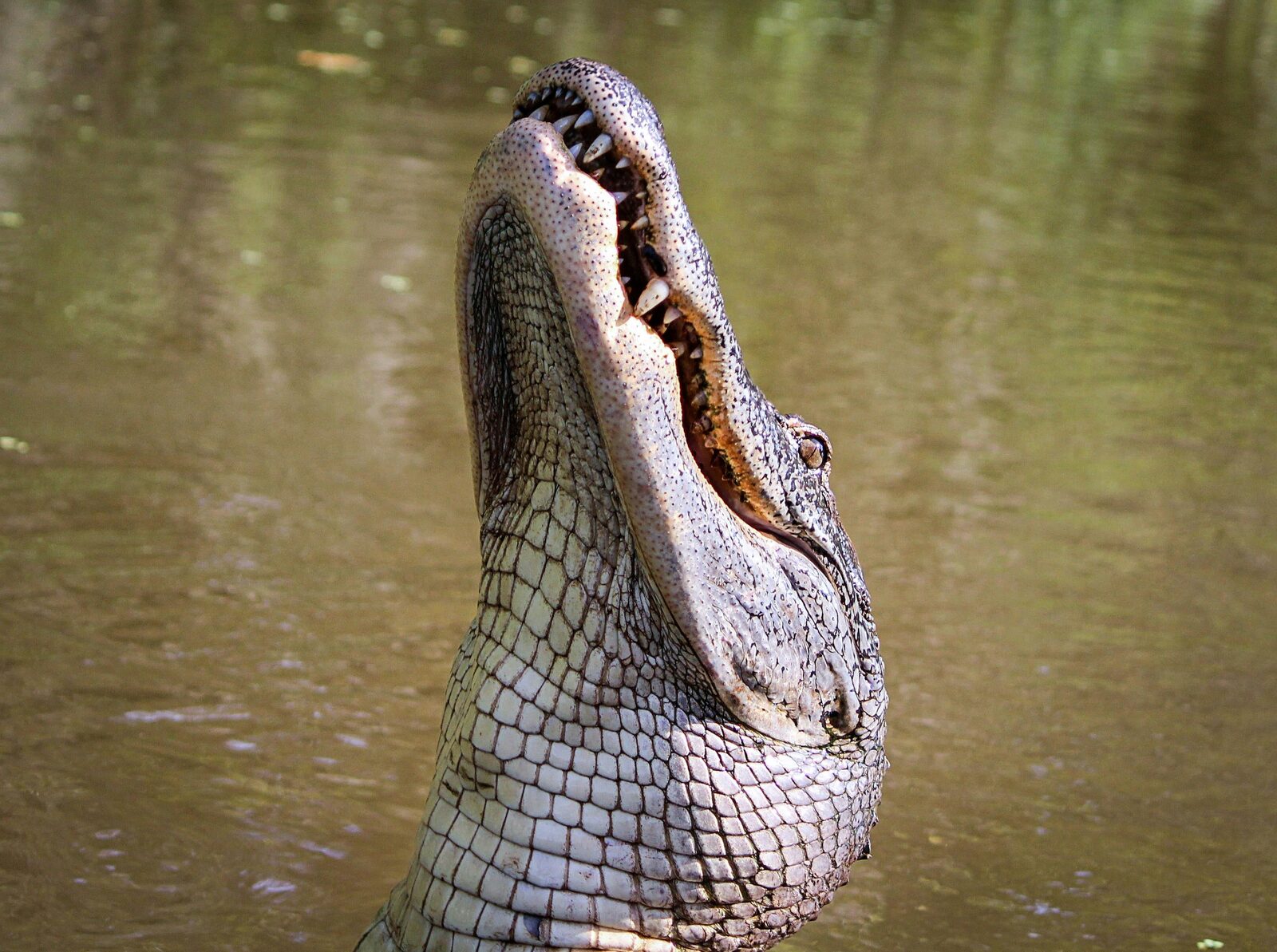
An alligator carries 74 to 80 teeth at any moment. Each one sits above its own replacement, so a worn or broken tooth is simply pushed out by the next. Over a lifetime an alligator may run through 2,000 to 3,000 teeth.
They are cones, not blades. They grip; they don't slice. An alligator cannot chew. Small prey goes down whole, and anything too large gets the death roll — a violent spin that twists a manageable piece free.
And then there is the party trick that sounds made up: the muscles that close those jaws are ferocious, and the muscles that open them are feeble. A jaw that clamps at over 2,000 psi can be held shut by a determined pair of hands.
Bite force, in company
Estimates vary by study and by animal, but the American alligator sits near the top of the measured range for living animals. Roughly, in pounds per square inch:
Comparative figures are widely cited approximations.
Eyes on Top
Eyes and nostrils both sit on the very top of the skull. Everything else can be underwater while the alligator watches you and breathes normally. That single design decision is most of what makes an ambush predator work.
Each eye has three eyelids. Two move up and down like ours. The third — the nictitating membrane — is transparent and sweeps sideways across the eye: built-in swimming goggles.
Behind the retina lies the tapetum lucidum, a mirrored layer that bounces light back through the light-sensing cells for a second pass. Combined with a retina packed with rod cells, it makes for excellent night vision — and it is why a torch swept across a dark bayou comes back with dozens of red points staring at you.
They appear to see in colour, too, though quite how much and to what end is still not fully understood.
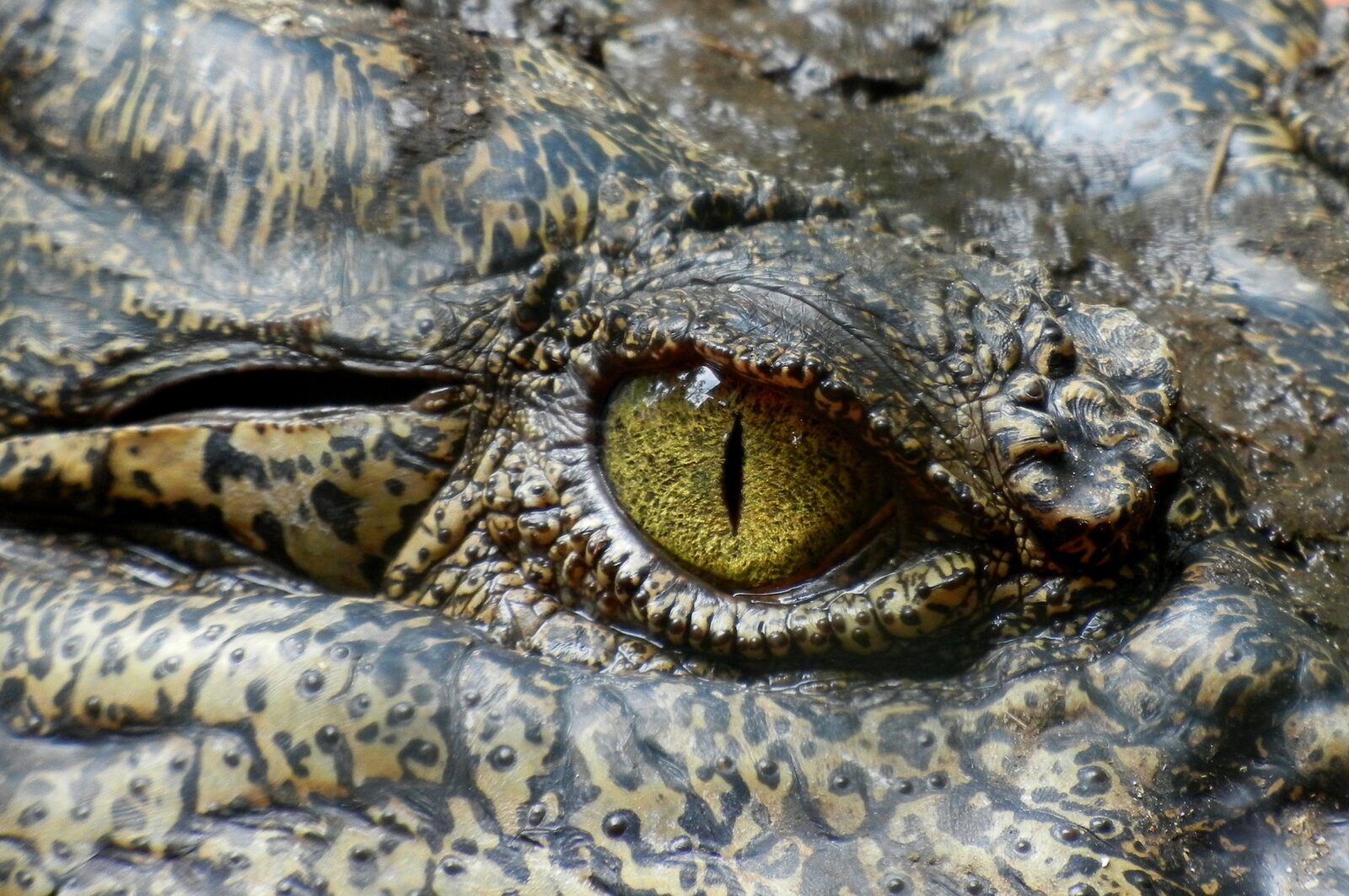
“A resting gator can hold its breath one to two hours. Its heartbeat slows right down — bradycardia, they call it. Swimming hard burns through that a lot faster. Ask me how I know.”
How Big Do They Actually Get?
Drag the slider. The silhouette is drawn to true proportion — a hatchling really is that small next to a record bull.
The usual numbers
- Male American alligators: typically 11–15 ft, commonly 500–1,000 lb.
- Females: usually 8–9 ft.
- Chinese alligators: much smaller — about 4.5–5 ft and 50–100 lb.
- Growth: fastest in the first few years, sometimes over a foot a year, then slowing.
Anything over 13 ft is exceptional.
The record books
In August 2014 a hunting party on the Alabama River took an alligator measuring 15 ft 9 in and weighing 1,011.5 lb — a state record for both length and weight.
Historical claims of 19-foot alligators exist, but the documentation and measuring methods behind them can't be verified, so they live in the same drawer as the fish that got away.
Exhibit complete
You know how a gator is built. Now find out how to tell one from a crocodile at fifty paces.